- Setback and Frontage Requirements.
(a) For all lots in all zoning districts, the minimum setbacks of structures from lot lines shall be as follows:
Front Yard: 25 feet (except in the Innovation and Technology Center District where the minimum front setback is 15 feet).
Side Yard: 10 feet
Rear Yard: 25 feet
(b) For lots abutting or containing zoning district boundary lines, setbacks shall be increased to 25' unless adjacent to the Residential I and Residential II zoning districts where the minimum setback shall be 50'.
(c) The minimum Side Yard and Rear Yard setbacks for accessory buildings in residential districts shall be 5'.
(d) Environmental Business District. Setbacks shall comply with the requirements of all districts, except the minimum Side Yard and Rear Yard setbacks for lots abutting Walker Road in the town of Shirley shall be 150' in addition to the public open space buffer parallel to Walker Road.
(e) Corner lots shall comply with the Front Yard Set back requirements for each side of the Lot that is parallel to a Street or Road.
(f) Refer to 974 CMR 5.02 for Innovative Residential Development minimum frontage and setback requirements.
- Streets and Roads.
All projects that include construction of new or alteration to existing Streets and/or Roads shall comply with 974 CMR 2.07.
- Parking.
(a) All Districts.
- Dimensional and Related Requirements.
a. In all districts, except where buildings are set back 150' or more in the Rail, Industrial, and Trade Related District (see below), parking lots shall be located to the rear and sides of the buildings with only visitor, handicapped, and preferential parking situated within the Front Yard setback. Preferential parking includes spaces for electric, hybrid and alternative fuel vehicles, carpools, vanpools, and other ridesharing vehicles. Parking allowed in the front of the building shall be limited to 10% of the required parking spaces in accordance with 974 CMR 3.04(3)(a)1.f.. The remainder of the parking serving the project shall not be located in front of the building facade. In cases where buildings in the Rail, Industrial, and Trade Related District are set back 150' or more, parking is permitted in the front of the building. In such instances, a landscaped strip between the front lot line and the parking lot, measuring at least 60' deep, shall be provided. On-street parking shall be considered in parking calculations for residential developments.
b. Parking spaces shall be at least 9' wide x 18' deep. Applicants may propose up to 10% of parking for compact car parking spaces. Compact car spaces shall be 8' wide x 16' deep. Aisle widths shall be at least 24'. All parking lots shall conform to Article XIV of the By-Laws.
c. Handicapped spaces (dimensions, locations, and so forth) shall conform to the Massachusetts Architectural Access Board (521 CMR). The number of designated handicapped parking spaces is based on the total number of spaces required (refer to table below). Handicapped parking spaces may be constructed in phases or reserved, although an adequate number shall be constructed with the initial phase. Additional handicapped spaces shall be constructed when the reserve or phased parking is constructed.
| Total parking spaces |
Required handicapped spaces |
| 15 to 25 spaces |
1 designated space |
| 26 to 40 spaces |
5%, but not less than 2 |
| 41 to 100 spaces |
4%, but not less than 3 |
| 101 to 200 spaces |
3%, but not less than 4 |
| 201 to 500 spaces |
2%, but not less than 6 |
| 501 to 13,000 spaces |
1.5%, not less than 10 |
d. No parking facility shall be used for servicing or repair of vehicles or the storage or display of merchandise or other objects that otherwise interfere with its availability for parking.
e. Landscape islands shall serve a functional purpose for stormwater infiltration and evapotranspiration, and should be used whenever possible to reduce runoff, increase groundwater recharge, and increase screening and shade with trees. Parking lots shall extend no more than 180' in either length or width without a landscaped island and a pedestrian connection through the parking area and pervious landscape island(s) that is a minimum of 5' wide and bordered by 3" caliper deciduous shade trees planted a minimum of 40' on center. The landscape areas shall be an 18' minimum width along intermediate islands, and a 10' minimum width for terminal islands and divider islands (see 974 CMR 3.06(2) Figure B). Parking lots measuring less than 180' in either length or width shall be divided into bays not greater than 72' in length by terminal or intermediate island (see 974 CMR 3.06(2) Figure B). Terminal islands shall be 10' in minimum width and intermediate islands shall be 18' minimum in width. In truck parking lots, the Applicant may consolidate intermediate islands, to allow 360' between intermediate islands, with intermediate islands constructed at 36' minimum width. Divider islands in truck parking areas shall be a minimum of 20' deep.
f. The number of parking spaces constructed may not exceed the number of spaces required by the Massachusetts Architectural Access Board and ADA plus those required by the By-Laws and Exhibit C therein. Except in the Innovation and Technology Center Zoning District, on-street parking is only permitted where approved by the DEC and consented to by MassDevelopment.
g. For residential developments, there shall be 2 off-street parking spaces per Dwelling Unit. The DEC may reduce this requirement where sufficient on-street parking is available.
h. There shall be bicycle storage facilities provided on site for all developments.
i. Parking lots and associated improvements shall comply with ADA and the MA Architectural Access Board Regulations (521 CMR)
- Construction Standards:
a. Parking lots, loading dock areas, and driveways shall be constructed of bituminous concrete pavement. The construction specifications shall be the following:
- Compacted subgrade, free of frost, roots, and debris.
- Eight inches (8") of compacted gravel sub-base conforming to Massachusetts Highway Department Standard Specifications for Highways and Bridges (MHDSSHB) M.1.03.0 Type A.
- Four inches (4") of compacted gravel base conforming to MHDSSHB M.1.03.0 Type B.
- Two inches (2") of bituminous concrete binder course.
- One and a half inches (1½") of bituminous concrete top course
b. The portion of the parking lots, loading docks, and driveway subject to truck traffic, truck and container storage, and other railroad related vehicles, shall be constructed of bituminous concrete pavement. The construction specifications shall be the following:
- Compacted subgrade, free of frost, roots, and debris.
- Eight inches (8") of compacted gravel sub-base conforming to Massachusetts Highway Department Standard Specifications for Highway and Bridges (MHDSSHB) M.1.03.0 Type A
(http://www.mhd.state.ma.us/downloads/manuals/1995Mspecs.pdf).
- Four inches (4") of compacted gravel base conforming to MHDSSHB M.1.03.0 Type B
- Three inches (3") of bituminous concrete base course.
- One and a half inches (1½") of bituminous concrete binder course.
- One and a half inches (1½") of bituminous concrete top course.
c. The Applicant may propose modifications to the pavement construction specification where anticipated traffic and usage justify a lesser standard. Modified pavement design calculations (including load bearing data of the pavement and underlying soil) and construction specifications shall be reviewed and approved by the DEC. Any remaining parking and driveway areas shall be constructed in accordance with 974 CMR 3.00. The Applicant shall provide the DEC gravel sieve analyses, compaction tests, and pavement slips during construction activities. The Applicant is also required to allow the Director or designated representative to monitor all paving activities to confirm compliance with the approved pavement modification. The Applicant shall pay for all consultant costs associated with construction inspections and monitoring.
d. Parking spaces and striping shall be painted according to the MHDSSHB. Lines shall be located along the sides and unless curbing is present, at the head of parking stalls. Lines shall be a minimum of 4" wide and shall be one consistent color, either reflective yellow or reflective white paint.
e. Parking lots measuring less than 10,000 square feet in area are encouraged to utilize an open drainage system to minimize the depth of detention/retention basins, reduce maintenance, and decrease construction costs. Parking lots subject to truck traffic, truck and container storage, and other related vehicles must utilize a pretreatment practice such as a biofiltration basin to remove metals, hydrocarbons, and associated pollutants if open drainage is used.
f. Parking lots that service Multi-Family Dwelling Units shall also comply with the following:
- Be paved (using pervious materials where feasible) and screened from the Street or Road in accordance with 974 CMR 3.04(8)(g) and (h);
- Have travel lanes no wider than 20';
- For parking lots with greater than 25 spaces, there shall be a pedestrian connection through the parking area and pervious landscape island(s) that is a minimum of 5' wide and bordered by 3" caliper deciduous trees planted a minimum of 40' on center.
- Intermediate landscape islands shall be provided for parking lots with greater than 8 spaces in a row (see 974 CMR 3.06(2) Figure B).
- LID techniques shall be incorporated in accordance with 974 CMR 4.08 to the maximum extent feasible.
- For Dwelling Units without garages, bicycle parking shall be provided at a rate of 1 space per Dwelling Unit in an on-site accessible, covered and securable area with at least one visitor bicycle space per 10 Dwelling Units but no fewer than 4 visitor spaces per project site.
- Structured parking below the building is encouraged.
- Provide pedestrian connections to public sidewalks and/or trails in any adjacent Streets or Roads.
- Landscape Treatments. Landscape Treatment around the perimeter and interior to the parking lot is required and shall be used to break up large expanses of pavement and manage excess heat (urban heat island effect) and stormwater; landscape treatments shall also be required to screen parking lots, dumpsters, loading docks. Parking lots shall be landscaped in accordance with 974 CMR 3.04(8).
- Driveways/Curb Cut Locations.
a. Any portion of any entrance or exit driveway shall not be located closer than 150' to the curb/gutter line of an intersecting street. For residential projects, this requirement may be reduced by the DEC as long as the DEC determines that the Applicant has adequately addressed safety concerns.
b. The driveway entrance radii curves shall be designed to accommodate the turning radii of the vehicles using the entrance.
c. There shall be a distance of at least 40' between any two driveways measured at their intersections with the street. For residential projects, this requirement may be reduced by the DEC as long as the DEC has determined that the Applicant has adequately addressed safety concerns.
d. Commercial, Industrial and Multi-Family Residential driveway widths shall be no greater than 24' for a two-way driveway and 14' for a one-way driveway. Residential driveways shall not be wider than 12' as measured at the intersection of the driveway with the Right-of-Way or way and shall not be graded in excess of 8%..
e. Intersection sight distances shall be provided in accordance with current AASHTO guidelines for prevailing (85th percentile) speeds on adjacent ways to ensure adequate safety.
f. Common driveways are encouraged in order to minimize curb cuts, improve safety, reduce paving costs, and lower impervious coverage. The Applicant shall execute a covenant or other acceptable legal instrument as evidence that separate property owners have the legal right to use and responsibility to maintain the common driveway. The DEC may disapprove a common driveway if it determines that the facilities will generate volumes of traffic that would require separate driveways or that the traffic generated from the individual sites cannot be safely combined.
g. A standard "STOP" shall be installed at the intersections of industrial and commercial driveways with Streets or Roads.
h. Applicants are encouraged to utilize pervious paving materials for the construction of driveways. Refer to 974 CMR 4.08(5) for LID techniques and pervious paving construction details.
- Fire Equipment Access. Access to buildings shall be kept clear of hazardous substances and obstacles that may, in the opinion of the fire officials, impede the proper placement of fire apparatus and personnel in case of emergency. The Applicant shall obtain a letter from the Devens Fire Chief stating there is adequate access for fire equipment. Access for fire equipment shall be provided and maintained on at least two sides of the building. Fire lanes shall be designated with pavement marking and signage.
- Parking Lot Phasing. If an Applicant proposes parking lot construction phasing, the Applicant shall demonstrate that the portion to be constructed is sufficient for the needs of the users of the proposed structure. The unconstructed parking area shall be large enough for anticipated needs and shall be shown in a contrasting graphic pattern delineated on the Site Plan. The Parking Lot Phasing plan shall address erosion and sediment controls before and during construction, and specifically cite measures to be implemented to minimize soil compaction in areas not to be paved until later phases. Surety or other adequate performance assurance to construct the parking lot at a specified time in the future may be required. The DEC may then approve the parking lot phasing if it determines sufficient parking will be provided for current needs and adequate assurance exists to construct the remaining parking area when needed.
- Common Parking Facilities. Parking facilities shared between two or more users are encouraged in all zoning districts to minimize excessive paving and the size and number of areas devoted to parking. Common (i.e. "public") parking facilities are allowed in all districts except the Open Space/Recreation district.
- Residential garages are discouraged from facing Streets and Roads. Where garages face the Street, they shall be set back a minimum of 10' from the front façade of the Dwelling Unit.
- Where Dwelling Units are accessible by Roads (alleys), vehicular access shall be permitted through the Roads (alleys) only. Garages may face Roads (alleys).
- Transportation Demand Management (TDM). All proposed developments shall demonstrate they have made reasonable efforts to consider and, where feasible, include TDM initiatives early on in the site design and layout process. TDM initiatives can justify a smaller amount of parking than is normally required. TDM initiatives that may affect the site design and layout include, but are not limited to:
a. Providing a minimum of 5% of total parking spaces as preferred parking for any ridesharing services (car/van vanpools)
b. Providing a minimum of 5% of total parking spaces as preferred parking for any hybrid or zero/low-emitting vehicles
c. Providing a minimum of 5% of total parking spaces with Hybrid/Electrical vehicle plug-in/recharge stations
d. Phased parking, shared parking and/or reduced parking requirements
e. On-street parking (requires approval from MassDevelopment)
f. Guaranteed Ride Home Program (for those who use alternative transportation or participate in ridesharing)
g. Employee Relocation Commuter Assistance Program (educating employees on transportation options)
h. Ridematching Services (reducing single-occupancy vehicle trips)
i. Flexible work hours/compressed work weeks (to reduce AM and PM peak traffic)
j. Public or private transportation options such as a Devens Shuttle Bus (providing access to Devens community services and local commuting options)
(b) Viewshed Overlay District. Parking lots in the Viewshed Overlay District shall be located on the far side of the building from the viewshed sensitive receptor and/or along the sides of the building [see 974 CMR 3.08(3) Figure C]. Parking lots shall not be located between the building and the viewshed sensitive receptor except for a maximum of 10% of the total parking spaces constructed which may be located between the principle building and the street that provides the frontage.
(c) Historic Overlay District. The Applicant shall demonstrate the feasibility of shared use of parking lots or the creation of common parking facilities has been investigated. If the investigation demonstrates feasibility, the Applicant shall present a plan to the DEC indicating a parking and access Easement for shared use of parking lots with the abutter(s). The Applicant shall provide evidence that an agreement has been made with the abutter and that the Easement has been recorded at the Registry of Deeds.
- Stormwater Management.
(a) General Provisions.
- Stormwater Management in Site Plan review generally consists of managing stormwater on the site. Stormwater may be retained and recharged on-site, removed by evapotranspiration, or connected to the public drainage system.
- The DEC encourages Applicants to consider the site's location, abutting and on-site natural resources, and topographic characteristics. The Applicant shall identify all Resource Areas as defined by 974 CMR 4.06(3), the anticipated site uses and intensities, and propose an economic, protective, and efficient stormwater management system that is consistent with the requirements of 974 CMR 4.06 and 4.08. All Applicants shall avoid and/or minimize clearing of mature vegetation.
- Low Impact Development (LID) Stormwater Management design shall be incorporated into the site plan to allow for the full utilization of the property while maintaining the pre-development characteristics of the site as though it were a "green field" (volume, frequency, peak runoff rate) to the maximum extent feasible. Maximizing the use of pervious areas minimizes stormwater runoff from a site, improves stormwater quality, and increases groundwater recharge. Maintenance of these on-site stormwater management systems must be incorporated into facility operations, and is the responsibility of the landowner. For requirements, design standards, and criteria for LID techniques, refer to 974 CMR 4.08.
- Drainage systems shall follow the requirements of the Devens Stormwater Pollution Prevention Plan, the Water Resources Protection Report, and the Water Resources Protection By-Law. For requirements, design standards, and criteria for stormwater management systems, refer to 974 CMR 4.08.
- Regardless of whether site drainage is handled on-site or conveyed to a common or public stormwater management system, on-site stormwater management reuse and recharge systems shall be used for roof runoff (excluding metal roofs), whenever feasible.
(b) Stormwater Management options for Site Plan Submissions: Site generated stormwater shall be managed on-site to meet green field requirements. Conveyance to a common system (operated by the owners of more than one lot), or to the Devens Stormwater System (DSS), managed by MassDevelopment is an option once green field requirements have been met and all reuse and on-site infiltration methods have been exhausted. Stormwater Management options shall include green infrastructure and LID techniques, including but not limited to vegetated swales, rain gardens, bio-filtration landscape islands, rainwater harvesting, and pervious pavement, where feasible, to achieve infiltration/capture/reuse of stormwater runoff on-site. Stormwater treatment trains may include a combination of LID techniques in addition to Conveyance Structures, Detention Basins, Extended Detention Basins, Retention Basins, swales and infiltration structures, water harvesting devices, and proprietary filtration and separation devices.
- For lots served by the Devens Stormwater System (DSS), the Applicant may connect excess site drainage to the DSS without on-site detention provided that the following standards are achieved:
a. The Applicant shall obtain written approval from MassDevelopment/Devens Engineering stating that the DSS can accommodate the anticipated peak rate of runoff for the 25-year storm event using the Natural Resources Conservation Service (NRCS) TR-55 method and that the DSS basins have adequate capacity to accommodate the 100-year storm event (TR-20 Methodology).
b. A Stormwater Pollution Prevention Plan for all disturbed areas, as defined in the Devens Stormwater Pollution Prevention Plan, shall be included.
c. An adequate system for collecting on-site stormwater has been designed for the premises.
d. There shall be no negative impact from drainage on abutting properties, nor any negative impact to any public or private water supply or designated potential future supply.
- On-site stormwater management systems for areas without access to the DSS shall include: Conveyance Structures, Detention Basins, Extended Detention Basins, Retention Basins, swales and infiltration structures, and water harvesting devices. There are an increasing number of on-site LID techniques which effectively mimic natural hydrologic conditions. These general categories are not mutually exclusive and shall be combined where appropriate as current Best Management Practices and comply with 974 CMR 4.08.
- All closed drainage systems shall comply with 974 CMR 4.08(6).
- Catch basins or other drainage features in loading/unloading and/or fueling areas shall be equipped with post-indicator valves (which are to remain in the closed position) on the outlets for containment in the event of any spills.
(c) Monitoring and Maintenance of Stormwater Facilities. The Applicant shall include a Stormwater Operations and Maintenance Plan in accordance with 974 CMR 4.08(7) as may be applicable. The Site Plan shall specify the construction and post development Maintenance Schedule in detail on the Utility Plan. This will ensure that all parties understand and are aware that a Stormwater Operations and Maintenance Plan exists.
- Topographic Alterations.
(a) Topographic alterations shall be minimized, such that buildings, roadways, parking, detention/retention facilities, and all other site improvements shall be located first in previously developed, cleared, disturbed, and/or improved areas of the site, before proposing topographic alterations in previously undisturbed or vegetated areas.
(b) Topographic alterations in undeveloped woodland areas within the setbacks may be approved by the DEC if it determines that the construction of earth berms or slopes will reduce any adverse impacts of development. Tree removal shall be allowed in undeveloped woodland within the setbacks to create a berm or other topographic alteration, so long as alterations are minimized. Replication of trees may be required by the DEC using the same standards established in 974 CMR 3.04 (8) (d) 8.
(c) Topographic alterations may be allowed to provide Improvements to the lot if no other access point can be made safely through already disturbed frontage or if all frontage is undisturbed, such that alterations are to the minimum extent necessary to construct the infrastructure.
(d) Earth removal shall comply with the By-Laws and 974 CMR 4.07.
- Site Improvements
(a) All Districts.
- Sidewalks/Trails:Sidewalks and Trails shall conform to the following requirements:
a. Sidewalks Standards in 974 CMR 2.07(5).
b. In limited circumstances, the DEC may allow sidewalks and trails to be located adjacent to a Street and/or Road only if it is constructed with a vertical curb separating the Street/Road from the Trail.
c. Principle building entries shall have an accessible pedestrian walkway connecting to pedestrian walkways within abutting Rights-of-Way or ways.
d. If pedestrian paved areas, such as a plaza, are larger than 20 square feet, pavement shall be cement concrete (pervious preferred) modified with a Solar Reflectance Index (SRI) of 29 or greater. Open grid pavement systems that are at least 50% pervious are a suitable alternative. Refer to 974 CMR 4.08(5) for LID techniques construction specifications.
e. When a portion of the public trail system, as shown on the Devens Main Post Trails report dated July 2001 and any amendments thereto adopted by the DEC, falls within the project site, the trail shall be constructed by the Applicant and an appropriate public access Easement shall be provided for that portion of the trail on the project site. Trails shall be constructed to the specifications in accordance with 974 CMR 3.06 (12) Figure L. or as approved by the DEC.
- Curbing.
a. Sloped granite curb, vertical granite curb, cement concrete curb and bituminous Cape Cod berm are allowed. Vertical granite curb or cement concrete curb is required at all driveway entrance roundings to the point of rounding tangency. Cast-in-place monolithic, reinforced, air-entrained concrete vertical curb and sidewalks or vertical granite curb is required where sidewalks abut driveways or parking areas.
b. Vertical granite curb, where provided, shall be Type VA4 as specified in Section M9.04.1 of the Massachusetts Highway Department Standard Specifications For Highways and Bridges (MHDSSHB) with a six-inch reveal. Granite transition stones shall be installed when vertical granite curb changes profile to sloped granite curbing or Cape Cod berm or where curbing transitions to areas with no curbs.
c. Vertical cement concrete curb, where provided, shall be as specified in M4.02.00 of the MHDSHB with a six inch reveal.
d. Sloped granite edgestone, where provided, shall be Type SA, SB, or SC as specified in Section M9.04.2 of the MHDSSHB with a six-inch reveal.
e. Catch basins shall have curb inlet stones with transition stones when sloped granite edgestone or Cape Cod berm is used.
f. Cape Cod Berm, where provided, shall be a Modified Bituminous Concrete Berm - Type A (1' width) as specified in Section 106.1.0 of the Construction Standards of the MHDSSHB.
g. Cast-in-place monolithic, reinforced, air-entrained concrete vertical curb and sidewalks shall conform to Section M4.0200 of the MHDSSHB for 4000 psi concrete.
h. Curbing may be eliminated in select areas where there is sufficient protection for the edge of pavement and any drainage and/or safety issues have been adequately addressed to the satisfaction of the DEC.
- Lighting. Site lighting shall conform to the Industrial Performance Standards (974 CMR 4.04). Lighting posts, fixtures, and housing shall be uniform dark earthtone colors and comply with the following:
a. Access Road/Parking lighting shall be 0.5-foot candles minimum (maintained), with 30' maximum height posts.
b. Walkway lighting shall be 0.5 foot candles minimum (maintained), with 15'-18' high posts.
c. All lighting shall be metal halide (HID), Compact Fluorescent (CFL) and/or Light Emitting Diode (LED).
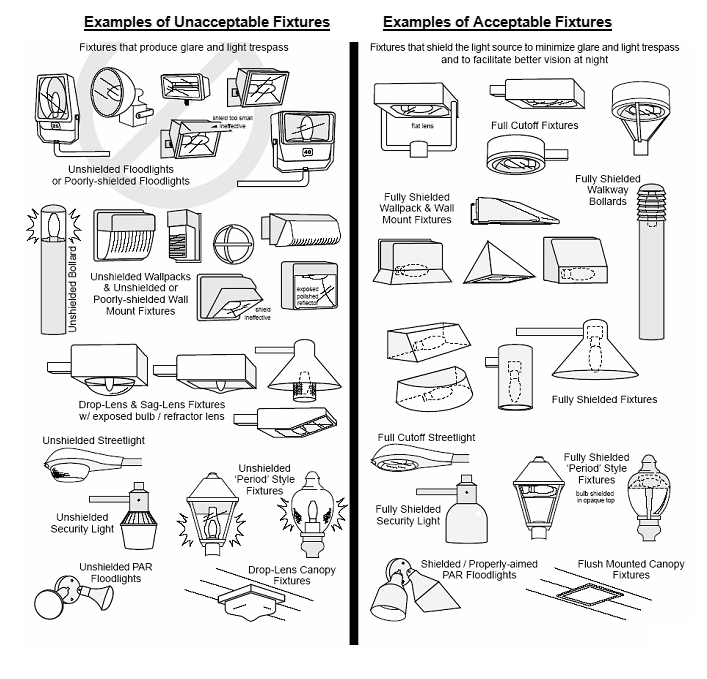
d. Bollard lights shall have roof optics with 100% sharp cut-off or shall have, at a minimum, louvered lenses, providing maximum cut-off and be of a single dark earth-toned color. Refer to Figure 1 for examples of acceptable fixtures vs. unacceptable fixtures.
e. Site lighting plan shall indicate location of proposed/existing trees to demonstrate that there is no conflict between proposed lights and proposed/existing trees within the site.
f. Commercial and industrial property lights may only be illuminated between 11 p.m. and 7 a.m. if the DEC determines lights are needed to ensure safety for night operations on the premises. This requirement does not apply to residential properties.
g. Lighting plans shall incorporate energy efficiency measures to the maximum extent feasible, including but not limited to LED Lighting, timers, daylight sensors and higher albedo ground surfaces/treatments to reduce number of fixtures required.
h. All light fixtures shall be equipped with appropriate shielding, filters, lenses, or cutoff devices required to eliminate light trespass onto any street or abutting lot or parcel, to eliminate glare perceptible to persons on any street or abutting lot or parcel and to minimize up-lighting.
i. Lighting attached to residential structures shall not exceed the height of the eave.
j. Street and/or Road lighting shall comply with 974 CMR 2.07(6).
k. Outdoor light fixtures used to illuminate an outdoor advertising sign shall be in compliance with 974 CMR 6.03(1)(f) and 974 CMR 4.04.
l. The following exemptions apply to this section:
- Lighting in swimming pools and other water features.
- Exit signs and other illumination required by building codes.
- Lighting for stairs and ramps, as required by the building code.
- Holiday and temporary lighting (less than thirty days use in any one year).
- Approved recreational field lighting, with proper controls to minimize glare and light trespass, and automatic shut off no later than 11PM.
- The temporary use of low wattage or low voltage lighting for public festivals, celebrations, and the observance of holidays are exempt from regulation except where they create a hazard or nuisance from glare.
m. The following light sources are prohibited:
- Mercury vapor and quartz lamps.
- Laser source light or any similar high-intensity light for outdoor advertising, when projected above the horizontal.
- Searchlights for advertising purposes.
Figure 1
- Service Areas, Dumpsters, and Open Storage
a. To the extent feasible, service areas, dumpsters, or open storage areas shall be located to the rear of buildings and placed on cement concrete pads.
b. Service areas, dumpsters, or open storage areas shall not be located forward of the front facade of the building.
c. Open Storage areas shall be designated on site plans. No open or exterior storage is permitted in undesignated locations.
d. Recycling storage and management details shall be provided. For facilities that generate food waste, details on the collection, storage and management of compostable materials shall be provided.
- Loading docks shall be located to the sides and rear of buildings and shall not be located forward of the front facade of the building.
- 69kV Power Line Easement Along Nashua River. A vegetated screen meeting the requirements of 974 CMR 3.04(8)(g) shall be planted within a 25' deep buffer that runs adjacent to the 69kV power line Easement. No portion of a Dwelling Unit shall be located within 100' of the 69kV power line and no Accessory Structures shall be permitted within the 25' deep buffer.
(b) Historic Overlay District: All development shall comply with the Regulations for Historic Districts in 974 CMR 7.00 and comply with the Programmatic Agreement between the Army, the National Advisory Council on Historic Preservation, and the Massachusetts Historical Commission. Site improvements shall comply with the requirements of all districts, except as noted:
- Sidewalks/Walkways. Brick paving with hand-tight joints (no mortared joints) or an asphalt-setting bed with bituminous or concrete sub-base. Pedestrian paved areas, such as a walkway or plaza, larger than 20 square feet shall be cement concrete (pervious preferred) modified with a Solar Reflectance Index (SRI) of 29 or greater. Open grid pavement systems that are at least 50% pervious are a suitable alternative. Refer to 974 CMR 4.08(5) for LID techniques construction specifications.
- Curbing.
a. Sloped granite edgestone shall be Type SA, SB, or SC as specified in Section M9.04.2 of the MHDSSHB with a 6" reveal.
b. Cape Cod Berm shall be a Modified Bituminous Concrete Berm - Type A (1' width) as specified in the MHDSSHB Construction Standards Section 106.1.0.
c. Cast-in-place monolithic, reinforced, air-entrained concrete vertical curb and sidewalks shall conform to section M4.02.00 of the MHDSSHB for 4000 psi concrete.
- Lighting. Lighting fixtures and poles shall comply with the Report: "Street Lighting Recommendation for Devens Historic Overlay District" prepared by Carol R. Johnson and Associates of Boston, MA, dated November 30, 2001. The DEC may allow alternatives within the interior of parking lots and in service areas. Alternative poles shall be a 30' maximum height with arm-type fixture, upward cutoff, and dark in color (post and housing), and shall be a style that is compatible and harmonious with the historic poles and the goals and objectives of the historic district as stated in Article X of the By-Laws.
- Utilities.
(a) Sewage Disposal.
- All sewage generated by site development at Devens shall connect to the Devens public sewer system. The Applicant shall provide evidence that the sewage generated by the proposed development shall be accepted by the Devens Wastewater Treatment Facility.
- Septic system construction is prohibited. Where a building is served by an existing septic system, the Applicant may continue to use on-site sewage disposal only if two conditions are met:
(b) Water Systems. Connection with the Devens water system is required for sanitary and fire suppression purposes. On-site wells may be used for irrigation or process water purposes with the approval of the DEC.
(c) Utility Extensions. The DEC may require Easements to allow utilities be extended to the undeveloped land abutting the site to allow for future connection with the public systems.
(d) Other Utilities. All proposed and existing public and private utility connections, extensions, and services shall be located or relocated underground.
- Landscape Treatment
(a) The existing landscape of Devens is diverse, containing natural wooded environments such as the Nashua River corridor, Mirror Lake, and Robbins Pond, as well as open meadows and ceremonial landscapes such as Rogers Field (parade ground) and the Fort Devens Cemetery. New development shall be respectful and sensitive to the dominant landscape character of the site and Devens as a whole.
(b) The purposes of Landscape Treatment Design Standards in Devens are to:
- Preserve and enhance the character of the Devens landscape.
- Provide attractive settings for new development.
- Provide the character of the abutting towns of Ayer, Harvard, Shirley, and Lancaster.
- Preserve and enhance local and regional open space resources such as the Oxbow National Wildlife Refuge.
- Preserve the integrity of valuable regional historic resources, such as the Devens Historic District and the Fruitlands Museum.
- Support and encourage the use of sustainable design principles and operating practices that preserve and enhance wildlife habitats, water quality and quantity, and overall health of the natural environment.
- Encourage the use of indigenous plant material to provide natural habitat and food sources for wildlife and to maintain ecological diversity and minimize potable water usage.
- Maintain high standards for active and passive recreation, conservation, and other public spaces in Devens and enhance property values for present and future development.
(c) General requirements:
- All required landscape treatments shall be located entirely within the lot.
- Native plants shall be used in appropriate locations, such that individual plants are selected for their ability to thrive in or adapt to the particular soil and light conditions they are placed in. (For a list of recommended native plants, see http://www.umassgreeninfo.org/fact_sheets/plant_culture/umass_native_plts.pdf).
- Under no circumstances, shall any plants be used that are recognized by the horticulture or agricultural industries as invasive, whether native or exotic (non-native). Non-native plants are those species listed as invasive and potentially invasive as per the Invasive Plant Atlas of New England (IPANE) and Massachusetts Invasive Plant Advisory Group. A listing of these plants can be found at http://eddmaps.org/ipane/ipanespecies/current_inv.htm.
- All plant material shall meet all American National Standards Institute (ANSI) standards for plant material as set forth in Z60.1: American Standard for Nursery Stock, latest edition. All plant material shall also meet certain standards of quality for form, structure, and health and have a minimum winter hardiness for Zone 5B, as determined by the American Standards for Nursery Stock.
- Minimum sizes for plant material, unless indicated elsewhere in this Regulation, shall be as follows:
a. Deciduous shade trees: 3" caliper;
b. Deciduous ornamental trees: 2" caliper, and;
c. Evergreen trees: 6' height;
d. Shrubs. For screening in car parking areas, 3' height; for other screening purposes (dumpsters, loading docks, etc.) 6'; any other purposes, 18";
- Landscape Treatments shall be laid out in informal drifts rather than formal rows and shall undulate with site topography. Individual clusters of trees or shrub beds are acceptable as long as the tree clusters and/or shrub beds overlap. Linear solutions shall be avoided wherever possible, unless the existing landscape treatment is so arranged.
- The Applicant may request that the DEC determine that existing vegetation is suitably located, sufficiently visually impervious, and vigorous enough to be substituted for material required by these Regulations.
- Plant material located within 20' of any road or other paved area shall consist of species recognized by the nursery, horticulture and botanical industries as being tolerant of roadway de-icing salts. (For a sample list of plants recognized as tolerant of roadway de-icing salts, see Appendix A, List II.).
- In Village Growth I and II, the Innovation & Technology Center, Business/Community Services, and within the Historic District Overlay Zoning Districts, trees may be located in near-urban conditions, near sidewalks or in plazas. In these cases, the Applicant shall propose trees that will tolerate or adapt to those conditions. (For a list of some plants that withstand urban conditions, see Appendix A, List III.).
- Landscaping shall be maintained in good condition in perpetuity.
- Disturbed areas intended for natural re-growth shall be, at a minimum, graded, loamed and seeded with a native New England wildflower and/or conservation seed mix. The planting of native trees, shrubs and other plant varieties is encouraged in these areas.
- Projects shall reduce the use of potable water for irrigation to the maximum extent feasible by implementing potable water reduction measures that factor in plant species, density and micro-climate as well as irrigation efficiency. Irrigation water shall be derived from detained treated stormwater (rainwater harvesting), or roof drainage, and/or reclaimed greywater (in accordance with 314 CMR 20.00) to the maximum extent feasible. Greywater" is wastewater discharged from domestic sources, including, but not limited to, washing machines, sinks, showers, bath tubs, dishwashers, or other source except toilets, urinals and any drains equipped with garbage grinders. On-site cisterns may be installed to store water for irrigation. The DEC discourages irrigation systems connected to potable water supplies [See also 974 CMR 8.09(11)].
(d) Preservation of Existing Vegetation [See also CMR 3.04(5)]
- Buildings, parking, loading docks, access roads, and other site elements shall be sited to preserve existing healthy mature vegetation and maintain natural topography to the maximum extent feasible.
- All trees with a minimum 12" caliper within the setback shall be preserved. Healthy existing wooded areas within setback areas where buildings cannot be constructed shall be preserved to the greatest extent feasible.
- The Applicant shall not propose topographic alteration within the root zone of any existing tree or wooded area designated as preferably preserved.
- All work within the root zone of existing trees to be preserved shall be carried out under the direction and supervision of a Certified Arborist. Should there be no feasible alternative, excavation for walkways, curbs, structures, and utilities within the root zones of preserved trees shall be by hand excavation until roots are encountered, bending smaller main roots out of the excavation area, and sawcutting all roots over 1" caliper. All exposed ends of sawcut roots shall be kept moist by covering the exposed ends with wet peat moss and burlap until excavation is backfilled. Existing trees that have had excavation or grade changes within their root zone shall receive crown pruning and root fertilization per the arborist's recommendations.
- Areas of previously cleared woodlands on site that are not utilized shall be re-planted with native woodland species. Edges of previously cleared woodlands on site shall be planted with a mix of blueberry, rhododendron, winterberry, bayberry, shrub dogwoods, cranberry bush, spicebush, native viburnums and other hardy shrubs to transition between natural woodland and more formally landscaped portions of a site. Where woodland areas are intended to serve as buffers, such plantings shall be used to fill in voids and rapidly reestablish undergrowth.
- Building structures, roadways, and paved areas shall be set back at least 12" from the drip-line of wooded areas and trees slated for preservation.
- Construction activities and site alterations shall not disturb the root zone of the trees designated for preservation. During construction, the Applicant shall install and maintain tree protection fencing, or other protective measures approved by the Director, located 12" beyond the drip-line of the trees to be protected.
- The Applicant shall be responsible to replace any trees designated to remain, which have been damaged, killed, or removed as a result of construction activities. The DEC requires replacement-in-kind, per caliper inch of deciduous trees and by height for evergreens. Two-inch caliper deciduous trees and 4' tall evergreens shall be the minimum size used for replacement. For example, if a 24" caliper deciduous tree is damaged or killed during construction, the Applicant shall replace the tree with six 4" caliper trees, or any other combination adding up to 24" caliper. A 36' tall evergreen, for example, shall be replaced with six 6' tall evergreens, or any other combination adding up to 36'.
- Vegetation shall be cleared from Right-of-Ways or way only as needed to accommodate roadway, utilities, and sidewalks. Significant trees (minimum 12" caliper) or woodland vegetation within the Right-of-Way shall be preserved by adjusting the alignment of utilities and sidewalks to avoid the trees. The Applicant shall provide tree wells for any grade change of 6" above or below existing finish grade within 6' of the trunk of a tree to be preserved. Use of dry laid fieldstone construction for tree wells is encouraged.
(e) Soil testing. In order to select plant material that is appropriate for the climate, soil type, light, exposure, and gradient of the site, the Applicant shall have the existing soil tested for both mechanical sieve and chemical analyses by an independent testing laboratory, such as an agricultural extension service or a local agricultural college. The sieve analysis shall be based on the USDA Classification System. The chemical analysis shall be according to the standards of the Association of Official Analytical Chemists. Should additional soil be required to be used, such as topsoil or planting mix, the new soil shall be tested in the same manner. The testing results shall include recommendations from the testing agency on what amendments, if any, may be needed for the soil to support the proposed plant material in a healthy and vigorous condition and whether the soil can support lawn or woody plants. The Applicant may include these soils tests within the Submission, or shall indicate within the Submission that such soils tests will be performed during the construction process prior to the use of any on-site or imported loam or topsoil. Submission to the DEC of construction phase soil tests and recommendations shall be made a condition of the Permit.
(f) Groundplane Treatment.
- All planted areas and "maintained' lawns shall pitch at 1:50 minimum slope, to ensure positive drainage on planted areas. Certain alternative groundplane treatments, such as native meadow grasses and wildflowers, may have a minimum slope of 1:100, particularly if the area is used for groundwater recharge or surface water treatment. "Maintained" lawns are those which are cut frequently, once or twice a week during the growing season.
- All unpaved areas with a gradient between 1:50 and 1:3 shall receive lawn planting as a minimum. Grass shall be provided using either sod, seed, or hydroseed methods, or a combination thereof. The Applicant is encouraged to limit manicured lawn areas to those immediately surrounding buildings, roads and parking lots. In all other areas, the Applicant is encouraged to propose alternative groundplane treatments such as native meadow grasses and wildflowers (For a list of native meadow grasses and wildflowers, see Appendix A, List I.).
- Any unpaved areas steeper than 1:3 shall be planted with shrubs or groundcover having fibrous root systems.
- Any unpaved groundplane visible from a Public Way, residences, the Open Space Zoning District, or the principal entrance of buildings on abutting lots and at a gradient of 1:1.5 to 1:1 shall be stabilized using bioengineering methods of erosion control, and 100% plant cover. Riprap or trap rock shall not be used to control erosion in these locations.
- No slopes shall be steeper than 1:1. Where space is limited, or the grade changes near preserved trees, the Applicant shall provide retaining walls to avoid slopes steeper than 1:1. Retaining walls shall be fieldstone, fieldstone-veneer and capstones on concrete retaining wall, or flat-face interlocking concrete masonry systems with split-face texture.
- Due to compacted soils having a higher runoff coefficient, there shall be no construction activities on parts of the site that are to be landscaped or left in their natural state. In areas where this is not feasible, methods to compensate for the compaction must be employed. Landscape areas shall be deep tilled to a depth of at least 12" to facilitate deep water penetration and soil oxygenation. Use of organic soil amendments (compost, sewer biosolids, and forestry by-products, but not topsoil or any mix with soil as an element) is encouraged to improve water drainage, moisture penetration, soil oxygenation, and/or water holding capacity.
(g) Screening
- Screening shall be a year-round visually impermeable barrier that may be either existing, constructed, or a combination thereof.
a. Existing screens may consist of natural topographic landforms, rock outcrops, or vegetation that is dense enough to be visually impermeable.
b. Constructed screens may consist of built screens, such as solid walls or fences, topographic screens, such as berms or landforms, vegetative screens consisting entirely of evergreen material, or a combination thereof.
- The use of existing vegetation, topography, and natural features to comply with screening requirements is encouraged.
- Screening is required to soften the visual impact of buildings, vehicle (car, bus, truck, etc.) parking areas, loading docks, trash disposal areas, exterior storage, and other unsightly areas associated with or generated by a particular development as viewed from Public Ways, residential zoning districts in Devens and host communities, the Open Space and Recreation Zoning District ("Open Space Zoning District"), and the principal entrance of buildings on abutting lots. The Director shall determine which Improvements shall be screened prior to or during the Pre-Permitting Conference.
- Screening may be required along the entire Front Yard setback or only a part of it. Screening may also be required to extend beyond the minimum setback areas or further into the lot, particularly if the building is located beyond the minimum setback or if the lot configuration is such that the visibility into Side Yard or Rear Yard setbacks is unimpaired from the Public Way, residences, the Open Space Zoning District, and principle entrances of buildings on abutting lots.
- A minimum of 50% of built screens such as walls or fences that face the Public Way, residences, the Open Space Zoning District, and principal entrances on abutting lots shall be softened with plantings.
- Vegetative screens shall be visually impermeable year round. Vegetative screens shall be a minimum of two shrubs deep, to a minimum depth of 6' and spaced at such an interval to achieve a visually impermeable screen within three growing seasons (i.e. spacing to be determined by expected rate of growth, not the shrub's mature size). The minimum height of a screen is 3' upon installation in car parking areas and 6' in other locations. A higher height shall be required if the parking area, loading dock, exterior storage, or other unsightly area is at an elevation lower than the Street, residences, the Open Space Zoning District, and principal entrances of buildings on abutting lots. The height of screens can be the result of combining landforms or natural elevation changes with vegetative material. Screens shall not be located so as to impede vehicular or pedestrian traffic.
- Where Improvements requiring screening such as truck parking, loading, service, disposal, or storage areas are adjacent to such Improvements on the abutting lot, the Applicant shall provide a screen that is 50% visually permeable, with the understanding that the owner of the abutting parcel is responsible for the other 50% of the screen. The DEC encourages shared responsibilities between abutters for providing and maintaining screening.
- Constructed landforms may be used in conjunction with built or vegetative screens. Constructed landforms shall be organic in shape, of differing shapes and sizes if more than one landform is proposed. The side slopes of constructed landforms shall be loamed and planted with vegetation to minimize erosion. Boulders and rocks may be used within landscape treatments, provided at least one-third of the height of the boulder or rock is below ground.
(h) Landscape Treatment in Parking Areas
- Landscape Treatment within parking areas shall provide visual and climatic relief from broad expanses of pavement and shall be designed to channel and define logical areas for pedestrian and vehicular circulation.
- The Applicant shall provide shade trees around the perimeter of all parking areas at a minimum ratio of one (1) tree per 25 lineal feet of parking lot perimeter. In portions of parking areas where screens are required, the Applicant shall provide shade trees along the perimeter at a minimum ratio of 1 tree per 50 lineal feet of parking lot perimeter in addition to the required screen. Trees shall appear informally arranged, rather than set in straight evenly spaced rows, unless existing trees or major site elements suggest a formal arrangement. Informally arranged trees may be clustered or grouped, if desired, as long as clusters/groups are not more than 75' apart.
- Internal parking area plantings are required. Exclusive of perimeter screen planting, internal parking lot landscape areas shall contain one deciduous shade tree for every 20 parking spaces. Trees shall be distributed throughout the parking lot as evenly as possible, although more than one tree may be located on a single island. Trees shall be set back at least 5' minimum from the face of the curb. Tree placement and parking lot lighting shall not conflict. Salt-tolerant shrubs shall be planted along divider islands, preferably native species clustered in groups of 5 or 7, at a rate of 1 shrub for each 10' of divider island length. Interior parking area plantings may be waived in truck parking areas if interior areas are screened from Streets, the principal entrance of any abutting building, the Open Space and Recreation zoning district, or residential zoning district with a year-round visually impervious screen at least 6' tall at installation and perimeter plantings are provided.
- Parking area terminal, intermediate, and divider islands shall contain no more than 25% impervious surfaces. The remaining 75% shall be landscaped with grass or other groundcover suitable to the Director. Shrubs planted in islands shall not exceed 4' in height where they might impede vehicular or pedestrian circulation.
(i) Viewshed Overlay Districts: The Viewshed Overlay District protects scenic vistas from the top of Prospect Hill and the Fruitland Museum. Affected areas in Devens are shown on Figure H in Appendix B. [974 CMR 3.06(8)]. The following apply to all projects within the Viewshed Overlay District:
- To the maximum extent feasible, buildings and all topographic alterations in the viewshed shall be located within previously disturbed areas (see 974 CMR 3.06(6) Figure F).
- Where buildings encroach on undisturbed wooded areas, the DEC may determine that such encroachment would have a significant adverse effect on the viewshed. To mitigate this adverse effect, the DEC may require that additional trees of at least 4" caliper or clusters of 3" caliper minimum to be planted. The DEC shall determine the spacing, density, size, and location of trees needed to soften the visual impact of the new construction.
- If substantial tree canopies do not exist between Prospect Hill and the building, vegetative screen on the side(s) of the building directly facing Prospect Hill may also be required (see 974 CMR 3.06(6) Figure F). This screen shall be located no further away from the building than a distance equal to the building height. Required screens shall extend the full length of the building facing Prospect Hill. Additional screening requirements:
a. Landscape Screen on Level Terrain in Viewshed Overlay Districts. If a landscaped screen is required on land at approximately the same elevation as the finished grade of the building, deciduous trees of 4" minimum caliper and evergreen trees of 10' minimum height (with at least one evergreen tree for every three deciduous trees) shall be planted at a density and location specified by the DEC (see 974 CMR 3.06(7) Figure G1).
b. Landscape Screen on Natural or Artificial Berm in Viewshed Overlay Districts. Where a screen is located on land higher than the finished grade of the building, the required deciduous tree caliper can be reduced by ½" and evergreen tree height can be reduced by 2' for every 3' of elevation difference compared to the finished grade of the building, to a minimum size of 3" caliper for deciduous trees and 6' height for evergreen trees. The number and location of trees planted shall be specified by the DEC.
- Buildings within the Viewshed Overlay District shall not have reflective metal flashing, mechanical enclosures, window frames or treatments, doors, roofing material, or building trim and all metal surfaces shall be finished with a dark, non-reflective finish. Rooftops shall not be illuminated. Signs shall be located below new or existing tree canopies.
- Vegetated Rooftops and Vegetated Walls. To the maximum extent feasible buildings within the Viewshed Overlay District that are visible from Prospect Hill at the Sears Estate and/or the Fruitland's Museum and/or residential uses outside of Devens shall have:
a. Vegetated roofs that comply with the DEC's Vegetative Roof Policy. A vegetated roof is a roof that is covered with vegetation and a growing medium, planted over a waterproofing membrane. It uses a root repellant system, a drainage and filter layer, and a growing medium of at least 4" and plants.
b. Vegetated walls on the sides of the building facing and visible from Prospect Hill at the Sears Estate and/or the Fruitlands Museum and/or residential uses outside Devens. A vegetated wall is a wall, either free-standing or part of a building that is partially or completely covered with vegetation and, in some cases, soil or an inorganic growing medium. There are two main categories of vegetated walls: vegetated façades and living walls. Vegetated façades are made up of climbing plants either growing directly on a wall or specially designed supporting structures. The plant shoot system grows up the side of the building while being rooted to the ground. In a living wall the modular panels are often made of stainless steel containers, geotextiles, irrigation systems, a growing medium and vegetation.
- Landscaping plans for projects located in the Viewshed Overlay District shall show the design and location of vegetated roofs and walls.
(j) Internal View Corridors (As a Site Design Consideration).
Within planned developments, such as Innovative Developments (By-Laws Article III, Section F. and 974 CMR 5.02), campus-like multiple buildings on one or more lots, or urbanized or commercial centers, the internal roadway system shall be landscaped and screened as though the drives are Streets, unless the DEC determines an alternative better suits the development layout and the character of the area. Required screens between adjacent uses within a planned development may be eliminated or reduced if the DEC finds that the screening on the lot effectively blocks views of parking lots, loading areas, refuse collection facilities, and other potentially unattractive areas from adjacent Streets and within the planned development. The Applicant shall prepare a landscape treatment plan for the entire planned development area, indicating areas to be screened, materials, locations and types of lighting fixtures, location and plant materials for parking lot buffers, location of signs, and other improvements as determined by the Director.
(k) Street Trees are shade trees located along a Road and/or Street.
- Where existing street trees are more than 50' apart on average or do not exist along a Street or Road, the Applicant shall plant street trees. Street trees shall be placed in a linear fashion along the Right-of-Way or way boundary, at a maximum spacing of 50' on center on all collectors and boulevards. The maximum spacing for all other Streets and Roads shall be 40' on center. Where the character of the site is predominantly wooded or pastoral, the Applicant may cluster trees informally along the lot line, with a maximum of 75' between clusters of three or more trees.
- Street trees shall be selected from 3.06(5) List V. The Applicant may request the DEC allow other species to be utilized.
(l) Landscape Treatment of Building Facades visible from Roads and/or Streets.
- The perimeter of all commercial and industrial buildings visible from a Road or Street, the principal entrance of adjacent or abutting buildings or from the Residential or Open Space Zoning Districts shall have continuous landscape treatment in the form of shade trees, ornamental trees, evergreen trees, shrubs, or a combination thereof within 50' from the face of the building. Landscape treatment shall consist of a minimum of one (1) shade tree per 50 lineal feet of building façade, or three (3) ornamental/evergreen trees per 50 lineal feet of building façade. Trees may be clustered or grouped, if desired. All trees shall be arranged in staggered, triangulated, or informal drifts, unless available space does not permit, or unless existing vegetation is geometrically arranged or unless such an arrangement is blocking required passive and/or active solar gain. Applicant may request a waiver to propose geometrically-based planting arrangements if the proposed building and site plan design strongly merits a more formal arrangement. Foundation planting is not encouraged, but may be allowed at or near primary and secondary building entries (not maintenance, service, or emergency egress entries). Where allowed, the landscaped foundation bed shall be a minimum depth of 20' in the Innovation & Technology Business, Innovation & Technology Center, Business/Community Services, Village Growth I & II, and Special Use I & II Zoning Districts, and a minimum of 10' depth in all other Districts. The landscaped bed shall consist of shrubs and groundcover to its full horizontal depth, with a minimum of 2 rows of shrubs.
- The Landscape Treatment adjacent to buildings may be reduced or waived by the DEC in cases where it is impractical to provide the specified depth of landscape area due to the size, shape, or other characteristics of the lot; however, in no case shall any parking space or vehicular lane be located closer than 10' from the building.
- Required landscape beds along building foundations may be substituted with remote (i.e., not abutting the façade) beds of ornamental or evergreen tree plantings.
(m) Landscape Treatment for Residential Projects.
- In addition to the required street trees, all residential projects shall include a minimum of one 3" caliper deciduous tree and one 6'tall coniferous tree (native species) per 5,000 square feet of lot area.
- For proposed Parks and/or Open Spaces without substantial natural/native vegetation, the DEC may require additional plantings for shade, heat island mitigation, and/or aesthetics.
(n) Maintenance.
- The owners of any lot shall be responsible for the maintenance of all landscaped open space, natural screens, and constructed screens within the lot. Landscape Treatment shall be maintained in good condition such that plantings shall be vigorous and in good health at all times and that the parcel shall present a healthy, neat, and orderly appearance, free from refuse and debris.
- The DEC may require a landscape maintenance and water management plan. The maintenance plan shall include but not be limited to the following:
(a) Integrated Turf Management/Integrated Pest Management Plan: mowing schedule, weed control, pest control, soil pH management, fertilizer plan, aeration/dethatching schedule, repair/replacement plan. Such a plan shall include steps for managing turf pests or diseases while minimizing inorganic and over-application of fertilizer and pesticide use and the corresponding negative impacts on the environment. Refer to the Integrated Pest Management Tools listed on the Landscape Nursery and Urban Forestry - UMASS Extension website at http://www.umassgreeninfo.org/.
(b) Shrub and Groundcover Management: mulch schedule, weed control, pruning where needed for visibility, preventative pest/disease management, repair/replacement plan. Mulch must be applied regularly to, and maintained in all, planting areas to assist soils in retaining moisture, reducing weed growth, and minimizing erosion. Mulches include organic materials such as wood chips, compost and shredded bark and inert organic materials such as decomposed lava rock, coble, and gravel. If weed barrier mats are used, the use of inert organic mulches is recommended. Non-pervious materials, such as plastic sheeting, are not recommended for use in any area of the landscape because of down-slope erosion, potential soil contamination from herbicide washing and increased runoff coefficients. Mulches shall be applied to the following depths: 3" over bare soil, and 2" where plant materials will cover. Mulches for stormwater management areas shall be heavier and not of a type that will float away.
(c) Tree Management: mulch schedule, weed control, deadwood removal, pruning schedule (particularly for trees adjacent to walk or roads), fertilizing schedule, preventative pest/disease management, repair or replacement plan.
(d) Water Systems Management: Water source, system description, spring start-up, fall close-out, system testing schedule, repair/replacement plan. The Applicant may install a permanent water supply system consisting of a sprinkler system and/or hose bibs placed at appropriate locations and intervals. Whenever possible, irrigation water shall be derived from sources other than the Devens water system, including reclaimed greywater, detained treated stormwater, roof drainage, or water from on-site wells. "On-site cisterns may be installed to store water for irrigation.
(e) Rodent control: design preventative measures, operational preventative measures, monitoring, schedule, remediative action plan.
(f) Seasonal Maintenance: Spring clean-up plan, fall clean-up plan, disposal plans for leaves and plant debris, winter plowing plan, winter deicing plan.
(g) All applications shall identify invasive plant species on the parcel and include an invasive plant species removal, treatment, monitoring program as part of the long-term maintenance requirements for the site. Species listed as invasive and potentially invasive as per the Invasive Plant Atlas of New England (IPANE) and Massachusetts Invasive Plant Advisory Group are prohibited from being planted and shall be included as part of any invasive plant species removal, treatment and monitoring program. IPANE website, including invasive species management resources can be found at http://eddmaps.org/ipane/ipanespecies/current_inv.htm. Invasive Species Management Plans shall include the following:
i. Integrated pest management (IPM) strategies;
ii. Procedure for identifying and monitoring for additional invasive species that may colonize the site and new species as recognized by IPANE;
iii. Initial treatment, follow-up treatments, long-term control including monitoring, and methods to dispose of invasive plant materials to prevent spread.
|
|